Discover what flex living is, how it works, and why it has become one of the fastest-growing real estate trends in Spain. We analyze its advantages, differences from coliving, and the opportunities it offers for investors
The way people live, work, and move has changed significantly over the last decade. Labor mobility, the rise of remote work, the digitalization of numerous industries, the internationalization of talent, and the search for more flexible experiences have transformed the residential needs of millions of people. Increasingly, individuals require accommodation solutions capable of adapting to professional, personal, or geographical changes without the limitations associated with traditional rental models.
Against this backdrop, flex living has emerged as an accommodation model designed to meet the needs of a society that demands greater freedom, integrated services, and spaces adapted to evolving lifestyles. Compared to more rigid residential options, it offers an agile alternative that combines housing, services, and community, enabling residents to settle in quickly and enjoy a more flexible experience tailored to their real needs.
In addition to these social and workplace changes, another factor is driving the growth of flex living: the need for social connection. Loneliness has become one of the major challenges facing contemporary societies. According to the World Health Organization (WHO), one in six people worldwide is affected by loneliness, while in Spain, the 2024 Unwanted Loneliness Barometer by Fundación ONCE and Fundación AXA indicates that 20% of the population experiences unwanted loneliness.
Its growth, therefore, is not only a response to a new way of living in cities but also to the need for residential solutions capable of combining flexibility, community, design, sustainability, and comfort within a single value proposition. The shared spaces, organized activities, and interaction opportunities that characterize flex living help create environments where it is easier to establish personal and professional relationships, providing a differentiating value that is becoming increasingly important for residents.
Flex Living: What Is It and How Does It Work?
The term flex living refers to a flexible accommodation model that combines apartments or studios managed by an independent operator with a wide range of services and shared spaces designed to enhance residents’ quality of life.
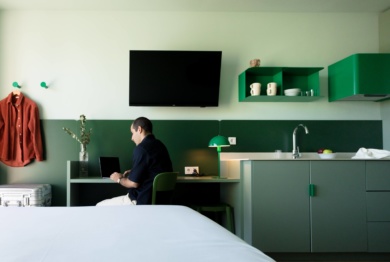
Unlike traditional residential rentals, residents can move into fully furnished and equipped accommodation without the need for extensive administrative procedures, utility contracts, or long-term commitments.
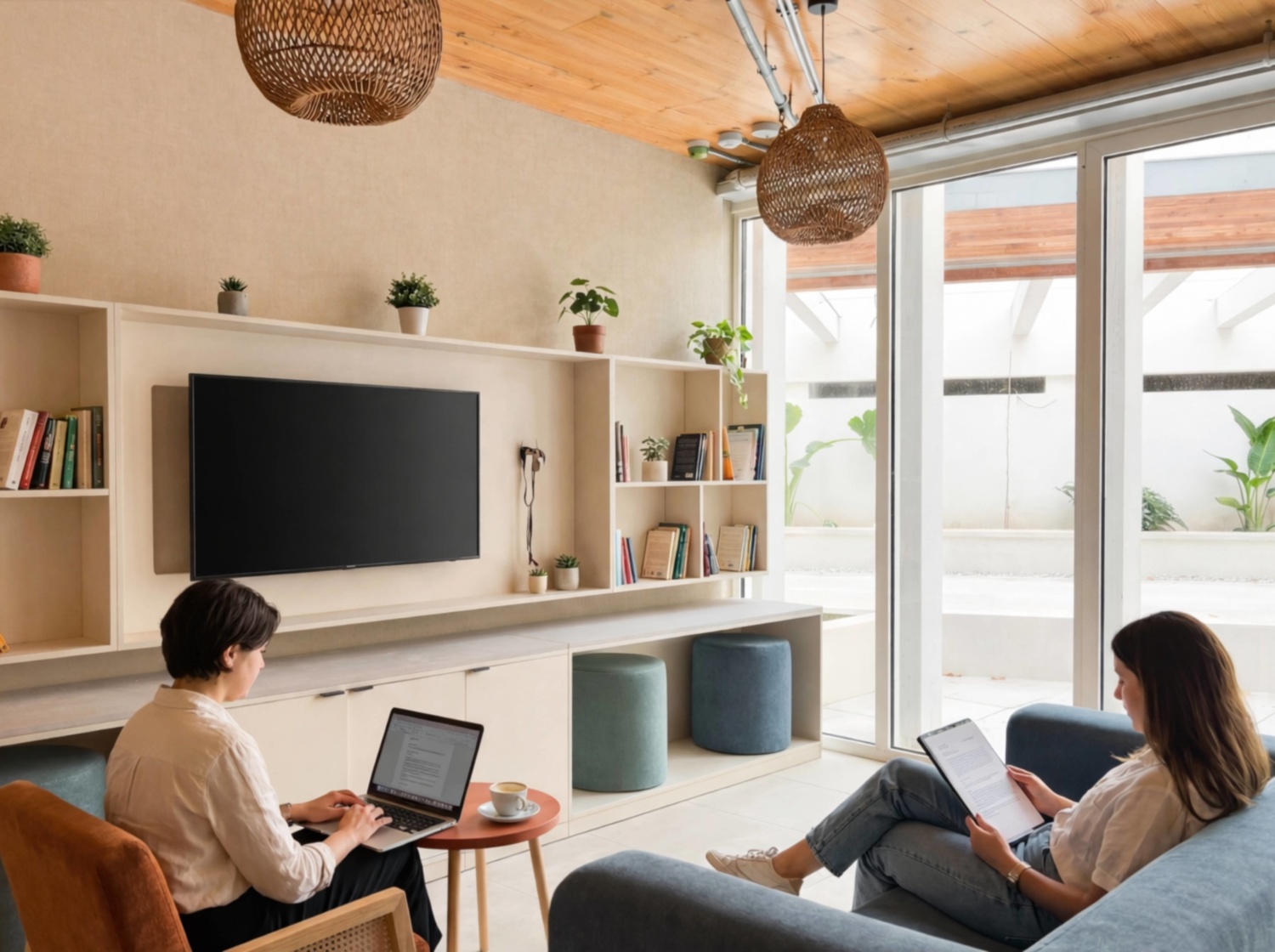
Flex living complexes typically include amenities such as:
- Coworking spaces
- Fitness centers
- Food and beverage areas
- Laundry facilities
- Outdoor spaces
- Leisure and entertainment areas
- Curated activities and event programs
The operator is responsible for managing these shared spaces while also fostering and supporting community life among residents.
Another key characteristic of flex living is the flexibility of stay durations. While these accommodations are generally geared toward medium-term stays, they can also adapt to shorter or longer periods depending on the resident’s needs and profile.
The Typical Flex Living Resident
Flex living appeals to a wide variety of resident profiles, although certain groups are particularly well suited to this model:
- Relocating professionals who temporarily move to a new city for work and seek an option that is more comfortable than a hotel and more flexible than a conventional rental.
- Digital nomads who work remotely and place a high value on connectivity, community, and the freedom to change destinations easily.
- Postgraduate students and participants in specialized training programs who require accommodation for several months without committing to long-term leases.
- International professionals relocating to a new city who need an immediate housing solution while settling into their new environment.
- Families in transition, such as those undergoing a relocation or home renovation, who require a comfortable, fully equipped temporary residence.
- Experience-driven individuals who prioritize services, design, community, and convenience over traditional homeownership.
A New Accommodation Model Already Established on a Global Scale
The growth of flex living is not exclusive to Spain. Major international cities such as London, Amsterdam, Berlin, and New York have been incorporating this type of asset into their real estate markets for years. The combination of growing demand, operational flexibility, and the ability to adapt to different user profiles has made flex living one of the most promising categories within the living sector.
This consolidation is also reflected in growing investor interest. The professionalization of operators, the maturity reached by the model, and the increasing demand for flexible accommodation have helped position flex living as an increasingly relevant alternative within real estate investment strategies.
Spain has also become one of Europe’s most dynamic markets for this type of asset. According to Colliers’ Snapshot Living in Spain Q1 2026 report, investment in the Living segment reached €2.386 billion during the first quarter of 2026, representing an increase of 186% compared to the average of the last five years and 236% compared to the average of the last decade.
The main reason is that flex living simultaneously responds to two major structural trends: on the one hand, it meets the needs of an increasingly mobile population that is less tied to a permanent location; on the other, it offers investors an asset class capable of adapting to different economic cycles and user profiles. All of this has contributed to establishing flex living as a stable alternative with significant long-term potential within the international real estate market.
The Flex Living Concept in Spain
Spain has become one of the European markets with the greatest potential for the growth of flex living. Factors such as the arrival of international talent, the rise of remote working, the strength of the tourism sector, and the appeal of cities such as Madrid, Barcelona, Valencia, Málaga, and Bilbao have driven the development of new projects in recent years.
The evolution of the market reflects a clearly upward trend. According to CBRE, Spain is expected to become the third European country with the highest number of flex living units in 2026, behind only France and the United Kingdom. This position consolidates the Spanish market as one of the main hubs for the development of this residential asset class in Europe.
From an investment perspective, Madrid currently concentrates the majority of activity within the sector. According to data published in CBRE’s Living, Market Data – Figures Q1 2026 Spain report, approximately 78% of investment allocated to the Living segment is directed towards the capital, reinforcing its position as the leading destination for real estate capital in Spain. Barcelona and Valencia complete the ranking of the most active markets for the development of this type of asset.
Financial prospects also remain positive. The same CBRE report highlights that prime yields in the Living segment remained stable during the first quarter of 2026, standing at 3.8% in Madrid and 4.0% in Barcelona. These levels reflect investor confidence in a category that combines growing structural demand with increasingly professionalized management models.
Advantages of Flex Living
Flex living stands out for offering a more flexible, convenient, and lifestyle-oriented form of accommodation. Compared to more rigid residential models, it allows users to move in quickly, enjoy modern spaces, and access integrated services without taking on unnecessary commitments. Designed with both wellbeing and functionality in mind, this model has become an attractive solution for those seeking freedom, community, and quality of life.
Its main advantages include:
- Adaptability: Spaces are designed to fit seamlessly into residents’ daily lives, allowing them to naturally combine work, leisure, and relaxation within the same environment.
- Community and networking: Many flex living complexes offer access to social events, collaborative areas, and shared spaces that encourage connections between residents, professionals, and people with similar interests.
- No long-term commitments: More flexible stay options are available, in some cases starting from just one month, making them particularly useful for those who cannot or do not wish to settle in the same city for extended periods.
- Predictable costs: In most cases, the main expenses and services are included within a single fee, making financial planning easier and reducing unexpected costs.
- Strategic locations: Flex living developments are typically located in urban areas, well-connected districts, or neighborhoods with growth potential, close to services, transport links, business hubs, and innovation districts.
- Flexibility in terms and duration: The model allows both the length of stay and certain accommodation conditions to be adapted to each resident’s actual needs.
- Smart investment: For investors, flex living assets can attract a broader audience, diversify demand, and support more efficient management focused on maximizing occupancy and asset performance.
The Difference Between Coliving and Flex Living
The concepts of coliving and flex living are often used interchangeably, as both share characteristics such as communal spaces, the creation of community among residents, and a commitment to more flexible residential solutions than traditional housing models. However, they are distinct concepts designed to address different needs.
Coliving initially emerged as a response to the difficulty of accessing housing in large cities and the need to create shared living environments for young professionals, entrepreneurs, and students. Its value proposition is based on sharing certain areas of the home, encouraging constant interaction among residents while reducing accommodation costs.
Flex living, on the other hand, has evolved from a broader shift in contemporary residential needs. Its objective is not only to provide temporary accommodation but also to deliver a comprehensive experience that combines independence, services, flexibility, and community. Residents retain the opportunity to interact with others while benefiting from a greater degree of privacy and autonomy.
One of the main differences between the two models is precisely the level of privacy they offer. While in many coliving developments the private unit is limited to a bedroom and much of daily life takes place in shared spaces, flex living typically offers fully equipped studios or apartments for the resident’s exclusive use. This allows individuals to enjoy a private home without giving up the benefits of being part of a community.
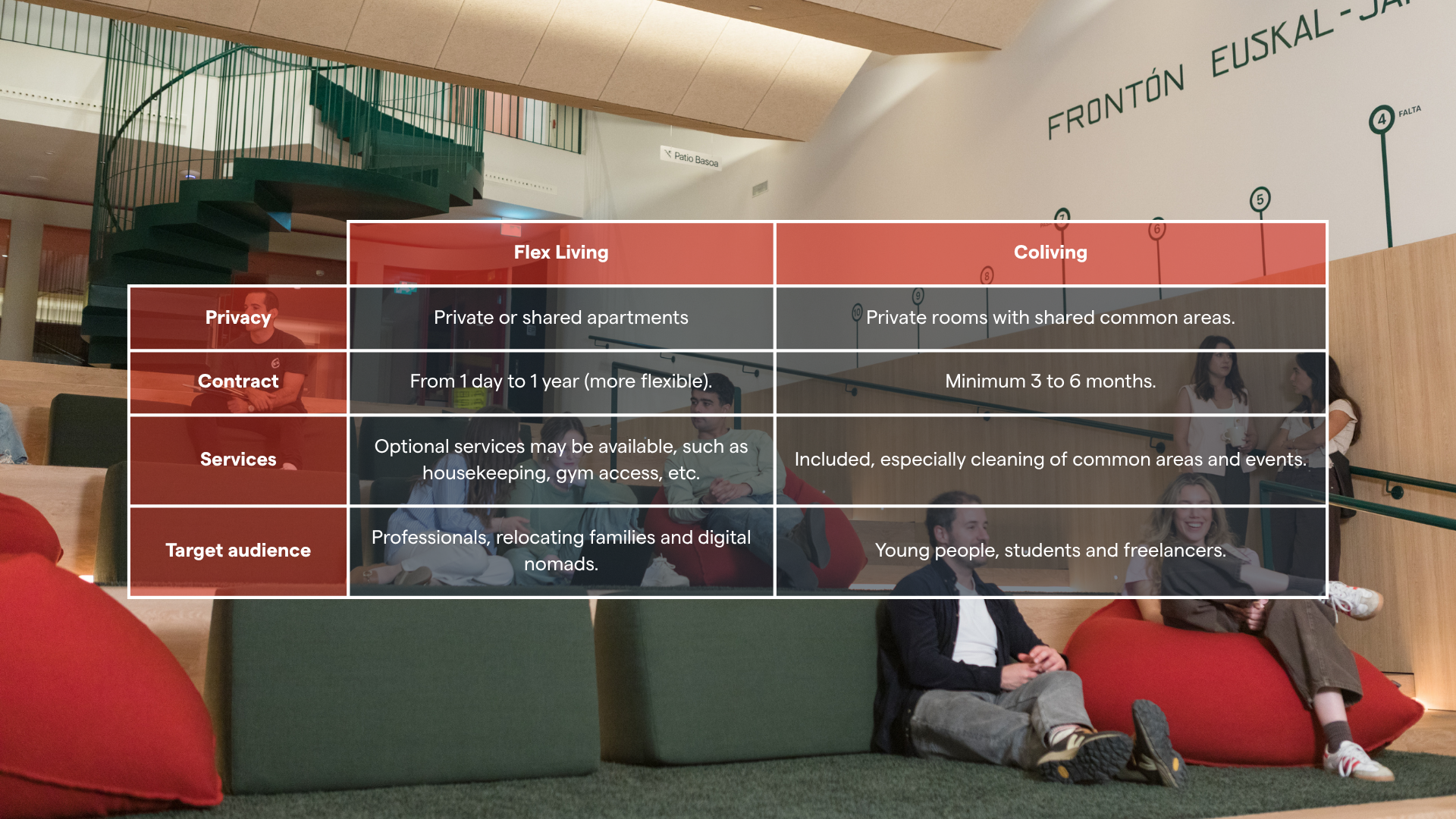
The duration of stays is another distinguishing factor. Coliving is generally geared towards medium- or long-term stays, whereas flex living is characterized by greater adaptability. In many complexes, accommodation can be booked for periods ranging from a single day to a full year, making it a particularly suitable solution for digital nomads, relocating professionals, or individuals going through a personal or professional transition.
In addition, flex living usually incorporates an additional layer of services that goes beyond accommodation itself. Coworking spaces, gyms, wellness areas, laundry facilities, food and beverage areas, reception services, maintenance, and activity programming are all part of a proposition designed to simplify everyday life and provide a more complete and personalized experience.
More than an evolution of coliving, flex living can be understood as a broader response to new ways of living, working, and moving. It is a model that allows residents to maintain the freedom and flexibility demanded by today’s lifestyles without sacrificing the privacy, services, and quality of life traditionally associated with having a home of their own.
Kora Living: Top 3 Fastest-Growing Flex Living Operators in Spain
The consolidation of flex living in Spain has been accompanied by the emergence of specialized operators capable of developing, managing, and scaling this type of asset professionally. Among them, Kora Living, Kategora’s hospitality brand specializing in flexible accommodation, stands out for having led one of the most significant expansions within Spain’s living sector in recent years.
Its growth is driven by a long-term vision based on developing complexes that were conceived from the outset to operate under flex living models. Unlike other initiatives that have emerged through the conversion of existing assets, Kora Living focuses on buildings specifically designed to meet the new residential needs of an increasingly mobile and flexible society. This strategy combines design, sustainability, efficiency, and user experience to create spaces capable of adapting to different ways of living, working, and connecting.
The company currently operates six complexes across strategic urban and leisure destinations. These include:
- Kora Green City, in Vitoria-Gasteiz, considered the largest Passivhaus accommodation complex in Europe.
- Kora Lluna, located in Valencia’s Cabanyal-Canyamelar district. With a BREEAM Excellent certification and more than 400 apartments, it has become one of Spain’s benchmark flex living developments thanks to its ability to integrate accommodation, community, and services within a single residential ecosystem.
- Kora Kiliki, in Pamplona, operational since late 2025.
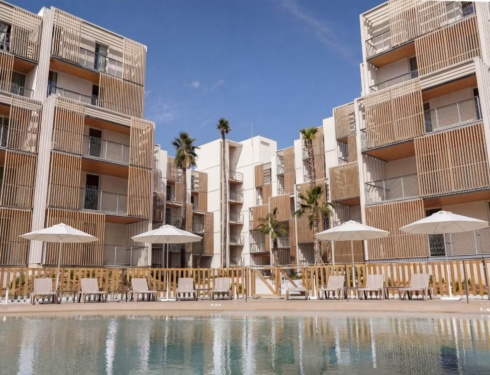
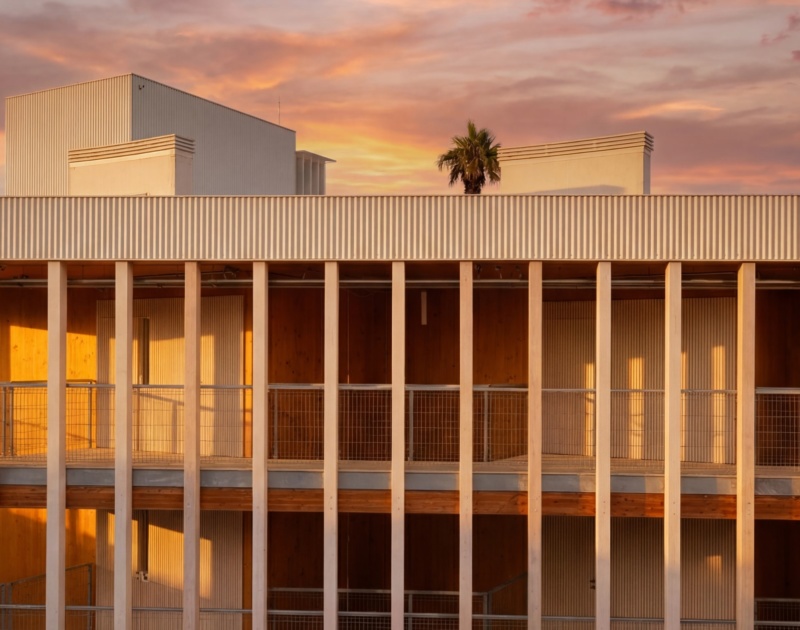
- Kora Olea, the largest hotel building constructed in timber in Southern Europe. Located in Torremolinos, it incorporates more than 3,500 cubic metres of radiata pine and larch structural timber, capable of storing approximately 3,500 tonnes of CO₂ within the building itself. The project marks the arrival of Kora Living and Kategora in Torremolinos, on the Costa del Sol, and has been operational since March while continuing its commercialization phase under the name .
- Kora Nivaria Beach, located in Abades, one of the most distinctive locations on Tenerife’s coastline.
- Kora Tigot, which opened its doors last December in Tenerife, just a few metres from the San Miguel Marina, where architectural design and integration with the natural environment are essential elements of its value proposition.
Beyond the real estate dimension of their assets, all complexes managed by Kora Living share the same philosophy: delivering a flexible residential experience where the privacy of individual apartments coexists with extensive communal areas, coworking spaces, wellness facilities, food and beverage offerings, and a continuous program of activities that encourages community building among residents.
Sustainability is another of the pillars that define the model. Kategora incorporates environmental criteria from the earliest stages of design and construction through energy-efficiency solutions, renewable energy systems, advanced consumption management technologies, and international certifications that ensure the environmental performance of its buildings throughout their entire lifecycle.
Kategora currently has more than twenty projects in different stages of development, which will allow the company to surpass 3,000 accommodation units in operation by 2027. These include:
- Kora Andorra, located in the heart of Avinguda Meritxell, with an opening scheduled for late 2026.
- Kategora Oceanika, the investment opportunity linked to Kora Olea, currently being marketed following the opening of the complex in March 2026.
- Kora Mostra, in L’Hospitalet de Llobregat, one of the most rapidly transforming urban areas within the Barcelona metropolitan region, with an estimated opening in 2028.
- Kora Volta, in Sant Adrià de Besòs, an area set to play a leading role in the urban regeneration of Barcelona’s waterfront, with operations expected to begin in 2028.
- Kora Lumen, located in MadBit, Madrid’s technology district, with an estimated opening in 2027.
- Kora Maresía, located in Costa Teguise (Lanzarote) and scheduled to open in 2027, representing an investment opportunity in a new resort living concept.
In a context shaped by professional mobility, hybrid working, the internationalization of talent, and changing residential habits, Kora Living is ideally positioned to support the growth of the living market in Spain. An evolution that is redefining not only the way people stay, but also the way real estate investment is understood.
All signs indicate that flex living will continue to gain prominence over the coming years. Just as coworking transformed workspaces and car sharing redefined urban mobility, this model represents a natural response to new ways of living in cities. For residents, it offers a new way of living. For investors, it represents an opportunity linked to one of the most significant real estate trends of the coming decade.
If you would like to learn more about the projects currently in Kategora’s portfolio, you can visit this website or contact the sales team directly at sales@kategora.com. They will be delighted to answer any questions you may have.