
Kategora Communications Dept.
10 min read

A practical case study based on real data to understand how a Flex Living investment with Kategora performs once the asset begins operations: profitability, occupancy, management, and the evolution of the complex

In a context where more and more investors are looking for assets capable of combining profitability, professional management, and a long-term vision, the Flex Living model has established itself as one of the most promising asset classes within the living sector.

But how does a Flex Living investment actually perform once the asset becomes operational? What kind of income does it generate? What expenses does the owner assume? How does the model work on a day-to-day basis?

To answer these questions, we present a practical case study based on a real investment made in Kora Green City, Kategora’s Flex Living complex in Vitoria-Gasteiz. Strategically located just a 15-minute walk from the Old Town and very close to the city’s commercial district, the complex has established itself as one of the leading Flex Living accommodations in northern Spain. Although the investor’s name has been changed for privacy reasons — Ander Sanz is a fictional name — all the financial and operational data included in this article are real. This example provides a clear understanding of how Kategora’s investment model works once the asset enters into operation.

An Asset Designed to Meet New Accommodation Needs and Lifestyles

In 2022, Kora Green City marked a new chapter for Kategora’s hospitality brand, Kora Living. A 180-apartment Flex complex designed to adapt to increasingly flexible and non-seasonal demand: relocating professionals, corporate guests, digital nomads, and mid-stay travelers seeking location, sustainability, and quality of experience.

Beyond its accommodation offering, the project also stands out for its architectural and energy concept. Kora Green City is the largest Passivhaus accommodation complex in Europe and is also considered one of the most energy-efficient accommodations on the continent. Both recognitions stem from the implementation — from construction through operational management — of renewable energy solutions such as aerothermal, geothermal, and solar energy systems, enabling 98% of its energy consumption to come from clean sources. This approach not only reduces environmental impact but also optimizes operating costs and improves the asset’s long-term efficiency.

All of this is supported by centralized management operated by Kora Living, Kategora’s hospitality brand specializing in ‘Flex’, ‘Urban’, and ‘Beach’ complexes.

The Kategora Model: A 360º Approach to a Unique Investment

Kategora has developed its own integrated approach covering every stage of the process: from opportunity sourcing and financial structuring to design, development, and operation of the complexes through Kora Living, its hospitality brand. This 360º approach enables a comprehensive view of the asset throughout its entire lifecycle while ensuring consistency between product, operations, and profitability. The model is structured around five core areas:

  • Opportunity sourcing and asset acquisition
  • Financial structuring and creation of investment vehicles
  • Architectural design and product conceptualization
  • Development and commercialization of the complex
  • Hospitality operations and asset management through Kora Living

Thanks to its experience in the living and hospitality sectors, Kategora develops projects specifically designed to meet new ways of living and an increasingly flexible demand. The goal is not simply to construct buildings, but to create assets capable of maintaining their value and competitiveness over the long term.

Additionally, the Basque company invests in its own projects, aligning its interests with those of its clients and becoming directly involved in the evolution and performance of each complex.

Sustainability as a Core Part of the Model

All of this is built on a philosophy where sustainability is not viewed as an add-on feature, but as an essential part of the model itself. Kategora believes it is possible to develop profitable assets without sacrificing positive environmental impact, focusing on energy-efficient buildings, sustainable materials, innovative construction solutions, and a long-term vision based on the durability of the assets.

In the case of Kora Green City, this philosophy translates into a Passivhaus-certified complex designed to minimize energy consumption and reduce emissions while optimizing operating costs and improving the asset’s long-term efficiency.

Kora Rewards: A Benefits Program Designed for Long-Term Investors

Complementing this model is Kora Rewards, Kategora’s exclusive program for investors, created to strengthen long-term relationships with clients and connect investment with the real experience of the assets.

Owners enrolled in the program enjoy benefits and discounts on stays at Kora Living-managed complexes. Conceived as a loyalty club, Kora Rewards aims to recognize investors’ trust and long-term commitment through exclusive benefits across the brand’s accommodation network.

The program features three tiers — SILVER, GOLD, and PLATINUM — and offers benefits such as:

  • Discounts ranging from 15% to 25%, depending on the season, across all Kora Living accommodations
  • Priority access to new developments and openings
  • Complimentary stays at future openings such as Kora Vella (Andorra), scheduled for late 2026
  • Exclusive benefits linked to new Kora Living projects and experiences

In addition, Kategora App provides a digital platform through which investors can continuously monitor their investments, consult documentation, and access updated information about their assets.

Both Kategora App and Kora Rewards reflect the company’s commitment to technology, transparency, and long-term investor relationships — three fundamental pillars of the Kategora model and an essential part of the experience the company aims to offer its clients.

This Is How the Investment Has Performed Since the Asset Became Operational

In September 2022, Ander Sanz (a fictional name) formalized his investment in Kora Green City through the acquisition of an apartment valued at €115,000. Just one month earlier, on August 28, 2022, the complex had officially begun operations under the management of Kora Living, marking the start of the asset’s operational phase.

Kategora’s investment model includes an initial six-month grace period following the signing of the deed. Once this period has elapsed, the owner begins participating in the income generated by the complex through a structure composed of:

  • A fixed quarterly return
  • An annual variable return linked to the actual operational performance of the asset

In the case of Kora Green City, the complex’s performance during its first years of operation has enabled the consolidation of stable and recurring income streams.

Income Evolution

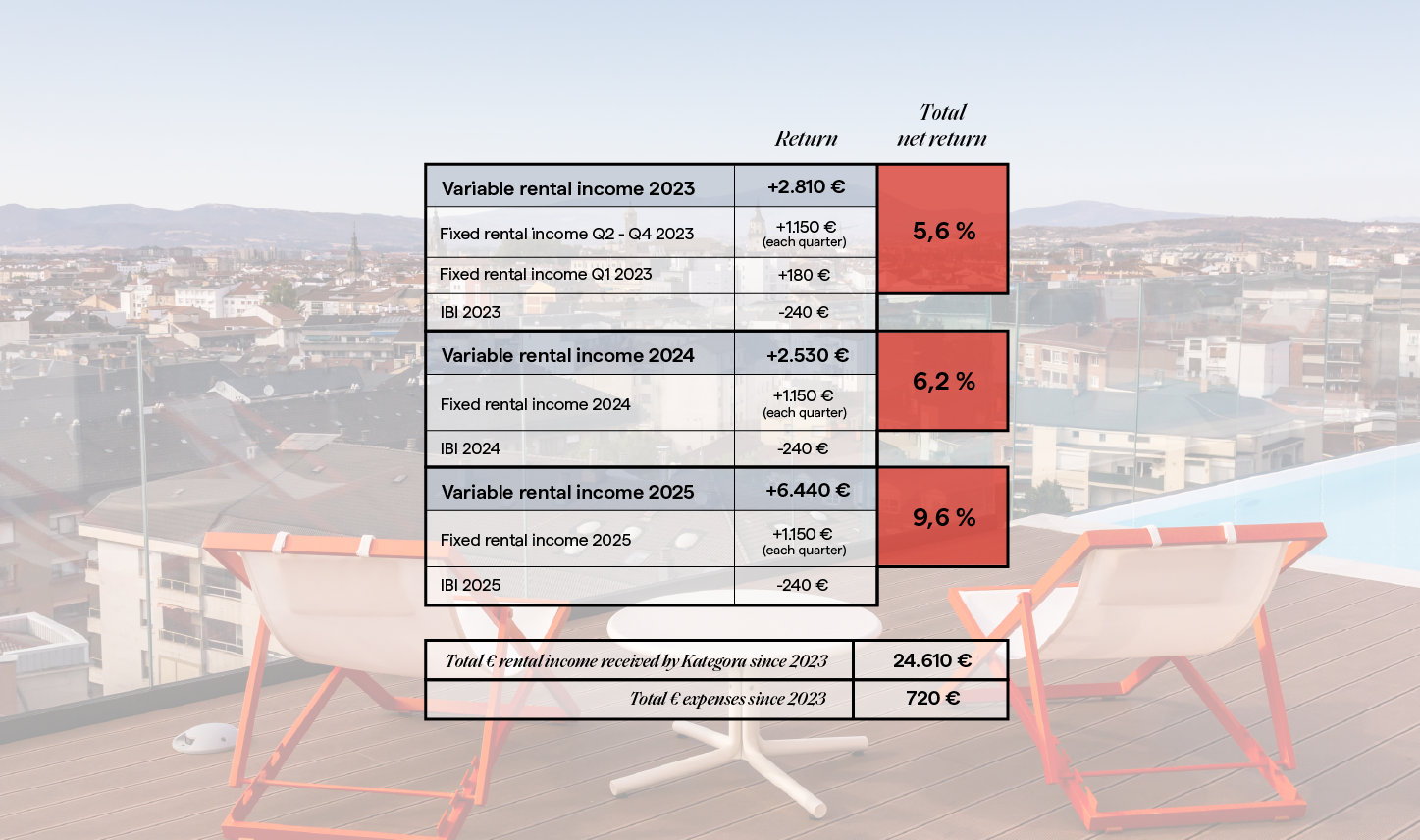
Throughout 2023, Ander regularly received the corresponding fixed quarterly payments, amounting to approximately €1,150 per quarter. In addition to these distributions, at year-end he also received a variable return exceeding €2,800 (5.6% annual net return), directly linked to the operational results achieved by the complex during the year.

The asset maintained this positive trajectory throughout 2024. Alongside new quarterly payments, the investor once again received a variable return exceeding €2,500 (6.2% annual net return), further consolidating a recurring income dynamic supported by the strong operational performance of Kora Green City.

In 2025, the complex continued to demonstrate solid growth, recording a new variable return of €6,440 and reaching a record annual net return of over 9% — approximately 50% higher than initially projected at the time of investment. This performance reflects both the operational consolidation of the asset and the strength of demand associated with the Flex Living model.
But beyond the quarterly figures, the most significant aspect has been the overall evolution of the asset since operations began.

A Complex That Has Exceeded Initial Expectations

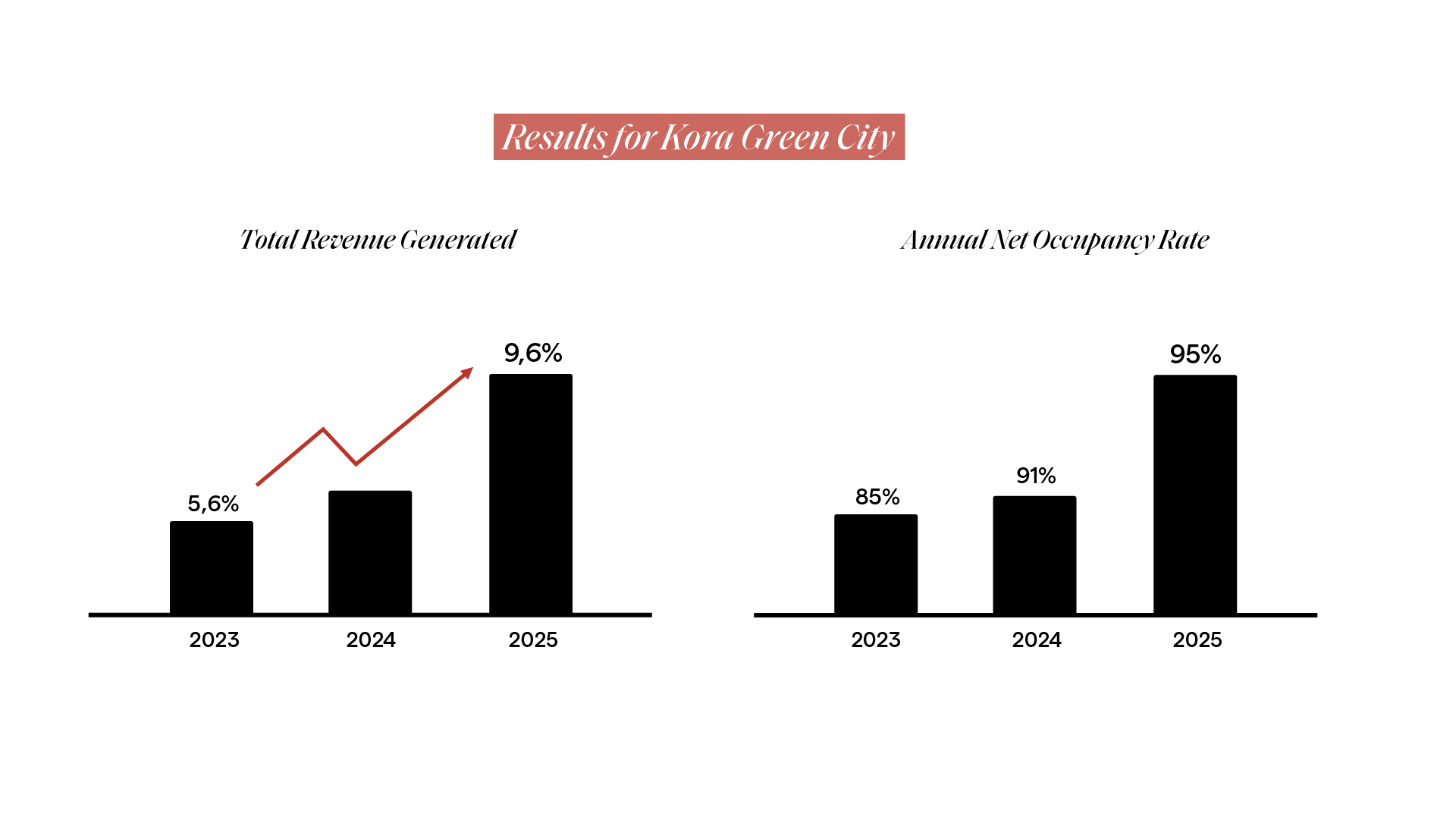
During 2025, Kora Green City achieved a 9.6% annual net return, approximately 50% higher than originally estimated at the time of investment. This performance reflects not only the strong evolution of the complex, but also the consolidation of an accommodation model that responds to new demand dynamics.

Behind these results lies particularly strong operational performance:

  • 95% average annual occupancy in 2025, reaching near full-occupancy levels and confirming the existence of structural demand for flexible accommodation in well-connected urban environments.
  • A 30% increase in RevPAR between 2023 and 2025, demonstrating efficient management of both demand and pricing strategy.
  • 78% of bookings generated through direct channels in 2025, representing an 18-percentage-point increase compared to 2024 and enabling optimization of intermediary costs while improving operational profitability.
  • High levels of guest satisfaction, with ratings of 9.1 on Booking and 4.7 out of 5 on Google in 2025, consolidating Kora Green City’s position as one of the highest-rated accommodations in its category.
This growth responds to an increasingly visible market trend: the rise of profiles seeking more flexible accommodation solutions — from relocating professionals to digital nomads — who find in Kora Living a differentiated alternative to traditional offerings.

A Hands-Off Investment for the Owner

While all this operational activity takes place, the investor remains completely removed from day-to-day management. Reservations, maintenance, marketing, guest services, and revenue optimization are all handled entirely by Kora Living, allowing the owner to benefit from the asset’s performance without assuming the typical complexities associated with more traditional real estate investment models.

In practice:

  • The owner’s only direct expense is property tax (IBI), amounting to €240 per year.
  • Full asset management is handled by Kora Living.

This balance between professional management, operational simplicity, and recurring income generation is precisely one of the key factors behind the growing interest in models such as Flex Living among investors who prioritize stability and a long-term vision.

The Possibility of Selling the Apartment at Any Time

In May 2026, Ander decided to sell his apartment for €152,000, achieving a capital appreciation of more than 32% over the original purchase price. This transaction reflects another of the distinctive features of the Kategora model: the owner’s complete freedom over the asset. Investors may sell their unit at any time, without penalties or restrictions, and are free to set both the sale price and choose the buyer.

The only requirement is that the new owner assumes the existing operating agreement and maintains the same management conditions through Kora Living. This system preserves the operational consistency of the asset and ensures continuity of the operating model, while simultaneously maintaining full individual ownership of each unit. Additionally, Kategora can support and advise owners throughout the sales process in order to facilitate the transaction and maximize the value of the asset.
Twenty Years Developing a Proprietary Model

The case of Kora Green City also comes at a particularly significant moment for the company. In 2026, Kategora celebrates its 20th anniversary under the claim ‘We continue building value, future, and legacy’, consolidating a journey that began in Bilbao and today includes more than 1,300 investors, a presence in three countries, and a portfolio of over 3,000 managed accommodation units.

Over these two decades, the company has developed a model that integrates design, sustainability, and hospitality operations under a single vision. An approach that ensures product consistency and supports the asset throughout its entire lifecycle.

Kora Green City perfectly represents this philosophy: an asset designed to meet new accommodation needs, professionally operated, and built to evolve over time. Because in an increasingly changing real estate market, more and more investors prioritize models capable of combining profitability, management, and long-term vision.

If you would like more information about the projects currently in Kategora’s portfolio, you can visit this website or contact the sales team directly at sales@kategora.com. They will be delighted to answer any questions you may have.

Frequently asked questions

  • What type of investment is this?
    This is a real estate investment based on the acquisition of apartments with delegated management and professional hospitality operations handled through Kora Living. The aim of the model is to maximize the asset’s profitability through centralized, comprehensive management, combining short- and mid-term stays — from one day to several months — while optimizing both occupancy and revenue generation.
  • Can it be used as a primary residence?
    No. The complexes are developed on tertiary-use land and operate under a hospitality regime, meaning they must legally be managed by a specialized operator, whether Kora Living or another authorized management company.
  • Are the returns paid monthly or annually?
    Returns are distributed quarterly. The fixed portion is divided into four quarterly payments, while the variable return — linked to the actual operational performance of the complex — is paid once per year following the closing and external auditing of the operating accounts, thereby ensuring maximum transparency for all owners.
  • Is the property’s profitability reduced when it is not occupied?
    No. All operating income and expenses are integrated into a single common pool and subsequently distributed among owners according to their participation coefficient, which is determined based on the amount invested.
  • Who covers extraordinary maintenance costs or special assessments during the building’s lifespan?
    Ordinary operating expenses — such as utilities, insurance, maintenance, or furniture replacement — are covered by the operation of the complex itself. Only in the case of extraordinary works approved by the homeowners’ association — for example, a major structural renovation or a full refurbishment of common areas after many years of operation — could an additional special assessment potentially be required.
  • Can the property be sold whenever the owner wishes?
    Yes. The owner retains full ownership of the apartment at all times and may sell it freely whenever desired, without penalties or restrictions from Kategora. The only condition is that the new buyer assumes the existing operating agreement and maintains the management conditions established through the operator. Additionally, Kategora supports and advises owners throughout the sales process to facilitate the transaction and maximize the asset’s value.